
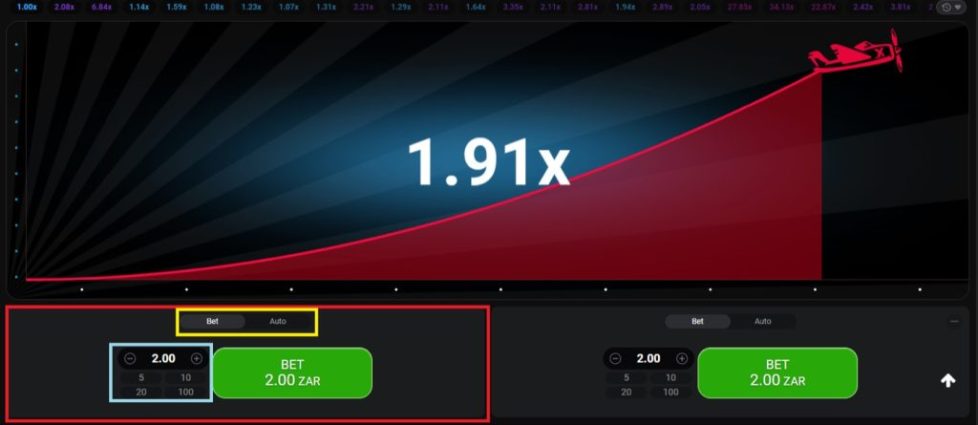
Aviator is a crash game developed by Spribe, a studio founded in August 2018 in Tbilisi, Georgia. The game went live in early 2019 and reached more than 300 operators by December 2020. Spribe describes it as a social multiplayer game consisting of an increasing curve that can crash anytime. It is not a slot, it has no bonus round, and its published return to player is 97%. Spribe reported over 10 million monthly players in October 2023.
This guide covers four habits that hold up when you check them against the math: start in demo mode, size each stake as a fixed share of your bankroll, set hard loss and win limits, and cap session length. None of these tips removes the 3% house edge, because no tactic can. What they do is slow the damage that variance can do to a balance. Set a budget you can afford to lose before you play, and treat the game as paid entertainment, not income.
How an Aviator Round Works
A round lasts about 8 to 30 seconds, and only a few seconds pass between rounds. An hour of continuous play therefore contains roughly 60 to 90 rounds, which is faster turnover than almost any table game.
Each round starts at a 1.00x multiplier. The curve climbs, and the round ends when the plane flies away at a crash point fixed before take-off. About 3% of rounds, roughly 1 in 33, crash instantly at 1.00x. If you have not cashed out before the crash, the stake is lost.
The result is committed in advance. Before each round the server publishes a SHA-256 hash of its seed, client seeds from players are combined, and the inputs are revealed afterwards. You can check any round with the verification tool inside the game. Neither the operator nor Spribe can change a result once the round starts.
One screen holds everything you need:
- two bet panels per round, each with its own stake and cash-out
- an Auto tab with Auto Cash-Out at a preset multiplier and Auto Bet for repeated stakes
- a round history bar showing previous multipliers
- a live bets panel with All Bets, My Bets and Top tabs
- an in-game chat and a Provably Fair badge
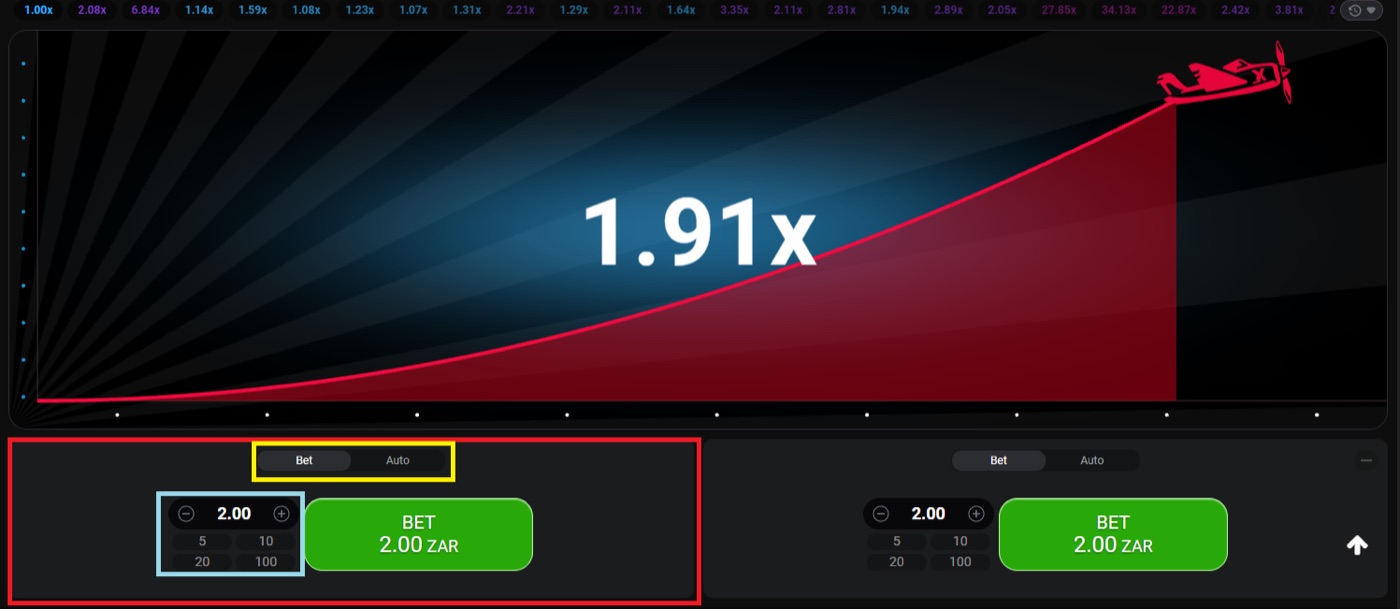
Two bet panels let one round carry a safe stake and a risky stake at the same time.
Why Demo Mode Comes First
Demo mode runs in a desktop, tablet or mobile browser and needs no registration. The game is built for low bandwidth and budget devices, so the demo behaves like the real thing on almost any hardware.
Demo play teaches pacing before money is involved. New players regularly misjudge how fast 8 to 30 seconds feels and how quickly 60 to 90 rounds pass in an hour. Ten minutes in demo shows the true speed of the game, including how often the curve dies at 1.00x.
Use the demo to rehearse:
- placing two bets in the few seconds between rounds
- setting Auto Cash-Out at 1.5x, 2x and 5x and watching the hit rates
- tracking a pretend bankroll of 100 stakes to see real drawdowns
- finding the round history bar and the Provably Fair badge
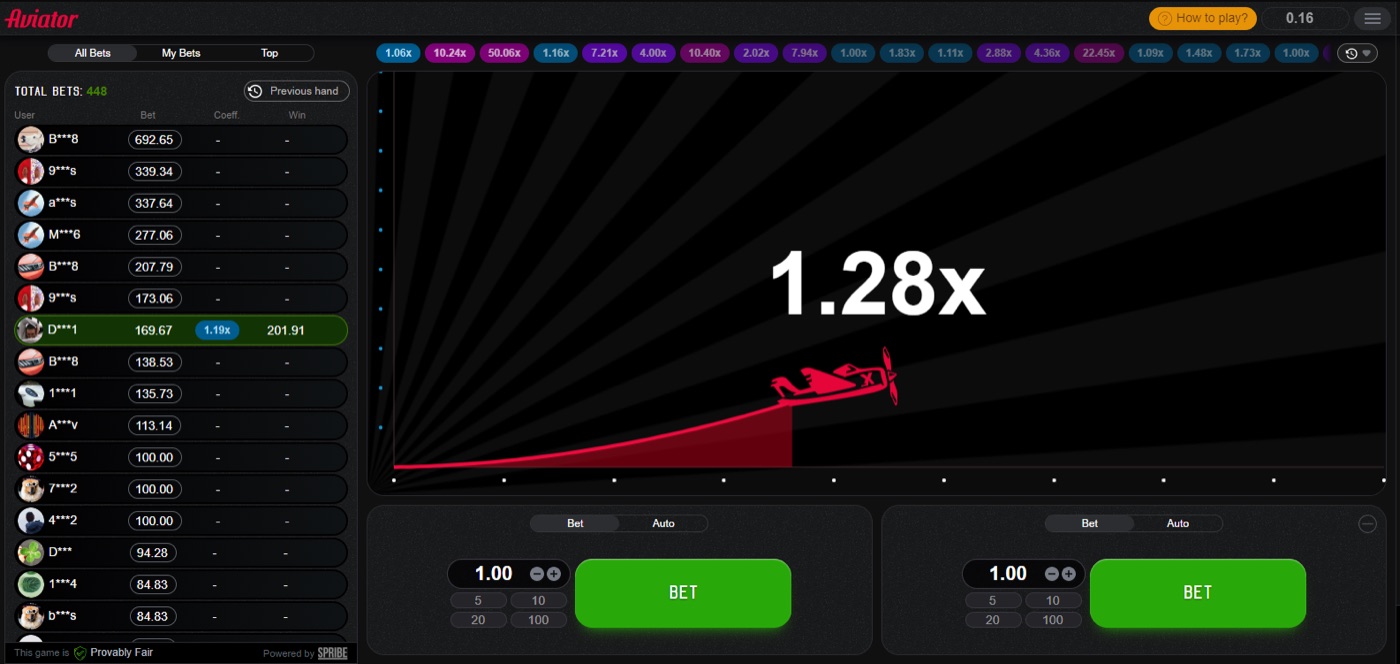
The demo shows the same rising curve and crash timing as real-money rounds.
Move to real stakes only after demo sessions feel routine. A player who still fumbles the cash-out button in practice mode will do the same with money on the line.
Stake Sizing That Survives a Losing Run
The standard guideline caps each round’s stake at 2% of your total bankroll. Stakes typically run from about $0.10 up to $100 per bet, and the exact minimum and maximum depend on the operator.
The 2% cap exists because Aviator is a high-variance game. Even a cautious 1.5x target wins only 64.7% of rounds, so losing streaks are a normal part of play, not a sign that something is wrong. At 2% per round, a run of ten straight losses costs roughly a fifth of the bankroll.
With a 5% stake the same run removes about half of the bankroll, and at 10% it removes nearly all of it. The table shows what flat staking looks like at both levels.
| Bankroll | 2% stake | 5% stake |
|---|---|---|
| $50 | $1.00 | $2.50 |
| $100 | $2.00 | $5.00 |
| $250 | $5.00 | $12.50 |
| $500 | $10.00 | $25.00 |
Set your stake in this order:
- Decide the bankroll for the week or month, money you can lose without harm.
- Multiply it by 0.02 to get the base stake.
- Round down to a value the quick-stake buttons offer.
- Keep the stake flat through wins and losses.
- Recalculate only when the bankroll has moved clearly, not after one session.
The two bet panels do not change this rule. If you run a split, the 2% applies to the combined stake of both panels, not to each panel alone.
Cash-Out Targets and Their Real Cost
The probability that a round reaches multiplier m is 0.97 divided by m. A 2x cash-out target therefore succeeds 48.5% of the time, and the rest of the ladder follows the same formula.
| Target multiplier | Chance the round reaches it |
|---|---|
| 1.2x | 80.8% |
| 1.5x | 64.7% |
| 2x | 48.5% |
| 3x | 32.3% |
| 5x | 19.4% |
| 10x | 9.7% |
| 20x | 4.85% |
| 50x | 1.94% |
| 100x | 0.97% |
The expected value is -3% of the stake at every target on that table. A low target trades big swings for frequent small wins, and a high target does the reverse. Strategy changes the shape of the ride, never the edge.
Guides converge on Auto Cash-Out at 1.5x to 2x for the steady style, and targets of 1.3x to 1.5x win roughly 65 to 75% of rounds. Realistic long-shot targets sit at 5x to 50x. Anything above that is lottery territory, since 100x appears in fewer than 1% of rounds.
The same multiplier feed reaches every player in a round, and integration layers such as spribe aviator api are how a bookmaker’s lobby displays one shared curve to thousands of simultaneous stakes.
The two-bet split uses both panels:
- panel one holds the larger share of the stake and auto cashes out at 1.5x to 2x
- panel two holds the smaller share and rides towards 5x to 10x
- the safe panel aims to cover the combined stake on winning rounds
- both panels still lose together whenever the round crashes early
Limits, Session Length and Auto Play
Auto Play runs 10 to 100 rounds with stop-on-win and stop-on-loss switches. At 60 to 90 rounds per hour, a session turns money over far faster than most casino games.
An example shows why a time cap matters. With a $2 stake and 75 rounds in an hour, the turnover is $150. At the published edge, the expected loss is about $4.50 per hour. Two hours doubles that figure without anything unusual happening, and short sessions simply cost less.
Set three numbers before the first bet: a loss limit, a win goal, and a round count. Auto Play’s stop switches can enforce the first two. A simple timer handles the third, because the game itself has no session clock.
A workable session plan looks like this:
- a fixed number of rounds, chosen before the session starts
- a loss limit enforced through the stop-on-loss switch
- a win limit enforced through the stop-on-win switch
- breaks between Auto Play blocks, using the pause between rounds
- off-peak play for a smoother connection, which improves response time, not odds
Operators sometimes drop free bets into the chat through the Rain Promo, where the first players to tap claim receive them. Promotions like that change the cost of a session, not the odds of any round, and their availability depends on the operator.
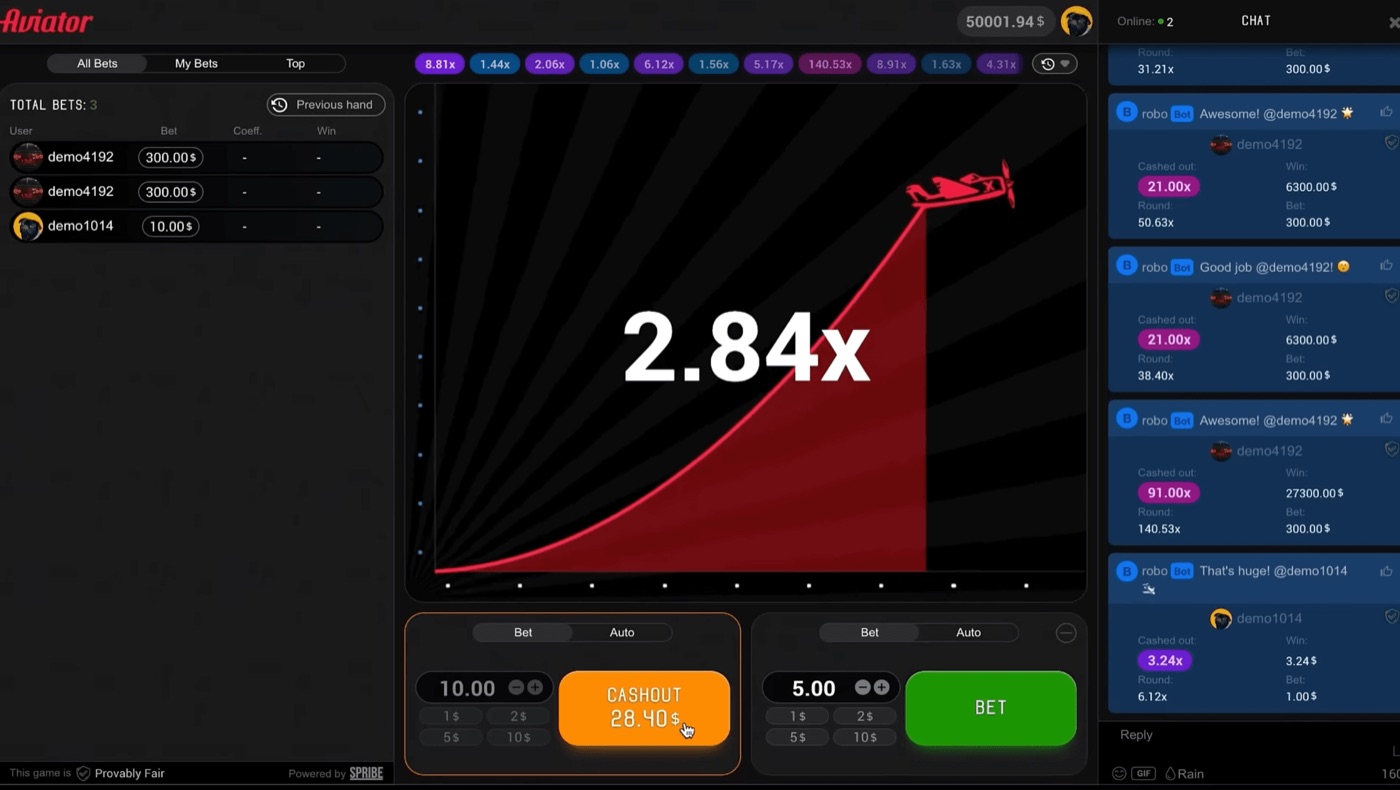
The live bets panel and chat sit beside the bet panels; in this round one player cashed out at 28.40x.
Systems and Apps That Fail the Test
Martingale doubles the stake after every loss and reaches 1,024 times the base stake after 10 straight losses. Fibonacci and D’Alembert are also named in guides, and all three lose to the same 3% edge over time.
Rounds are independent. The crash point of the next round is fixed by a hash published before take-off, so pattern reading, graph analysis, a best time to play and strategy chart PDFs cannot change the odds of anything.
Prediction apps fail for the same reason. There is no standalone official Aviator app from Spribe; the game runs inside an operator’s website or app. Predictor downloads on app stores and APK mirrors are third-party clones with virtual-coin disclaimers or ads, and version names like v4.0, v8 or v12 are marketing, not products.
Telegram signal bots resell public math, and some operators warn players directly not to spend money on Aviator predictors. Treat each of these as a cost, not a tool:
- Martingale, Fibonacci and D’Alembert staking plans
- any app or APK that claims to predict the crash point
- Telegram or chat signals sold per day or per week
- pattern charts built from the round history bar
Aviator FAQ
Is there an app that can predict Aviator?
No. The crash point is committed by a SHA-256 hash before the round starts, and the inputs are revealed afterwards for checking. Apps and APKs sold as predictors are third-party clones, often built around virtual coins with no real value. Prediction is impossible because the result is fixed before take-off.
Can you play Aviator for free?
Yes. Demo mode exists at operator sites and at demo.spribe.io and needs no registration. Some operators also grant free bets through chat Rain promos or individual offers, and what is available depends on the operator.
Is Aviator rigged?
The provably fair system publishes the server-seed hash before each round, and the crash point is fixed before take-off. Neither the operator nor Spribe can change a result after the round starts. Complaints about different results per account usually confuse variance with manipulation.
Why did my cash-out time out?
The cash-out request must reach the server before the crash. Guides point to latency or a slow device as the cause of time-outs, not a changed result. A stable connection, off-peak play and a preset Auto Cash-Out all reduce how much manual timing matters.
What stake size should I use on Aviator?
Risk no more than 2% of your bankroll per round, counting both bet panels together. Typical stakes run from about $0.10 to $100 per bet, but the real minimum and maximum depend on the operator.